Bloomberg’s Anuradha Raghu, Sara Bapat, and Agnieszka de Sousa reported that “the Iran war risk premium that swept through crop and fertilizer markets is rapidly evaporating as fears of prolonged supply disruptions fade, easing one of the biggest threats to food inflation.”
“Prices of urea — one of the world’s most important crop nutrients — have plunged more than 30% since mid-April, wiping out the gains triggered by the conflict,” Raghu, Bapat and de Sousa reported. “That’s dragging down prices of corn, wheat and other farm products, with the Bloomberg Agriculture Spot Index tracking 10 of the world’s most-traded crops falling to its lowest level since March 5 on Friday.”
“It’s a dramatic reversal from the early weeks of the war when the effective closure of the Strait of Hormuz choked off about a third of globally traded urea supplies, sending prices soaring and leaving farmers scrambling for alternatives,” Raghu, Bapat and de Sousa reported. “The decline may curb farm input costs and slow the pace of food inflation, but experts caution that energy prices remain elevated, while fertilizer is still sensitive to flare-ups in Middle East tensions.”
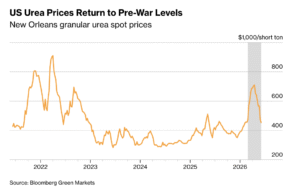
Bloomberg’s Ilena Peng reported that “prices for granular urea in New Orleans dropped to $453.50 per short ton, the lowest level since Feb. 6, according to Friday data from Bloomberg Green Markets. That’s down 36% from mid-April, when markets spiked to the highest levels since 2022.”
“Urea is the most common form of nitrogen fertilizer, the class of crop nutrients that faced the most immediate price reaction to the US’s attacks on Iran and the ensuing blockage of the Strait of Hormuz,” Peng reported. “Nearly half of the world’s urea exports come from countries affected by the conflict, according to the Fertilizer Institute.”
“The drop in demand comes as US farmers have largely finished applying fertilizers for the spring planting season. Meanwhile, the US and Iran are trying to reach a deal to reopen the Strait of Hormuz,” Peng reported. “Oversupply and weak demand have been pressuring urea prices in the US, Bloomberg Intelligence analysts Daniel Cole and Alexis Maxwell said last week. Domestic prices have in some cases fallen below that of more import-reliant countries like Brazil, potentially encouraging exports.”
High Fertilizer Prices Over Last Few Months Could Slow Brazil’s Ag Edge Over U.S.
Reuters’ Ed White, May Angel and Oliver Griffin reported that “Brazil’s cheap, abundant land has long helped the country’s farmers create vast, low-cost farms, allowing them to wrest export markets from U.S. farmers hurt when China began switching suppliers during President Donald Trump’s tariff wars.”
“While U.S. farm acreage has not grown this century, Brazil’s has soared about 50%, making it an agricultural powerhouse. But the South American country’s edge is being tested as the U.S.-Israeli war with Iran sends fertilizer prices soaring,” White, Angel and Griffin reported.
“The U.S. produces much of its own fertilizers, but Brazil relies heavily on imports, so many of its farmers have cut back on fertilizer purchases,” White, Angel and Griffin reported. “Even if the conflict ends tomorrow, industry experts say Brazil’s farmers are in trouble. Already, they are saddled with thousands of acres of farmland producing diminishing returns or even losses. Many are starting to accumulate significant debt.”
“In addition, many U.S. farmers have land rich enough to produce decent yields, even if they skip some fertilizer applications for a year. Few Brazilian farmers can do that,” White, Angel and Griffin reported. “…Unlike their U.S. rivals, Brazilian farmers cannot count on government bailouts or generous support programs. ‘Profitability just isn’t there,’ said Murilo Rabelo Martins Pereira, a farmer in Goias state in central Brazil. ‘Expansion is something everyone is rethinking right now.'”